The Story behind the optomap Retinal Exam
This is an inspiring story about how one man, after observing a tragic incident in his own family sought to develop a technology so that others could be spared the pain of avoidable vision loss.
Douglas Anderson of Dunfermline, Scotland, remembers the day well. His son Leif had suffered a spontaneous retinal detachment at age 5, despite going in each and every year for comprehensive eye exams. Douglas recalls speaking with the eye doctor at follow up, and being reassured that Leif was receiving state-of-the-art eye care, but at the same time hearing from the doctor how difficult it was to get a good look inside his eyes. Children have a hard time sitting still during medical procedures, and unless general anesthesia is used (not practical for most eye exams) often only a fleeting glimpse of the inside of the eye is possible. Leif unfortunately went blind in his left eye from complications related to the retinal detachment.
“The eye examination seemed intrusive, crude and – most importantly – ineffective,” says Anderson. “The thought struck me that there was nothing to stop me from trying to provide a better solution.” He soon put his company, Crombie Anderson Design Consultants, to work. The goal was to develop a product capable of producing a single, high resolution, ultra-widefield image of the retina. It would have to do this through an undilated pupil and be so easy and quick to use that a 5 year old could be easily imaged.
The first prototype was developed in 1994. Called the Panoramic200 it enabled eye doctors to visualize 200 degrees of the retina (compared to 15-20 degrees with typical office equipment) with the click of a button. Soon after, Anderson formed a new company to manufacture the Panoramic200 – his son Leif, 9 years old at the time, named the company Optos after the Greek word for vision.
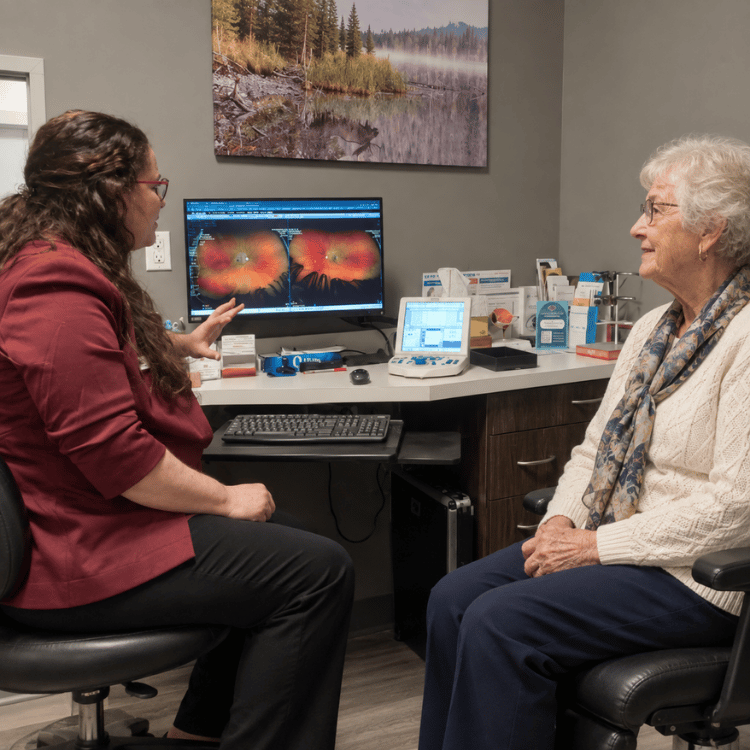
Today, proactive eye doctors use the Panoramic200 during routine eye exams to screen children and adults alike for diseases such as melanoma, diabetic eye disease, and retinal holes and detachments. Most diseases internal to the eye have no symptoms in their early stages, therefore, seeing as much of the retina as possible is essential to ensure the eyes are healthy. In May, 2011, Optos announced that 30 million optomap procedures had been performed worldwide since the company’s inception.
About the success of Optos, Anderson says “With the Panoramic200…I’m thankful to be able to – hopefully – help other families avoid unnecessary and avoidable vision loss.”
At Mountain View Optometry, we have had the Panoramic200 at each office since October 2008. It has certainly increased our confidence that we are seeing all there is to see, and in doing so providing the most advanced eye care available for our patients. It has helped us diagnose a variety of conditions that would have been difficult if not impossible to spot without it. We recommend an
optomap scan at every regular adult
comprehensive eye exam and every second comprehensive exam for children 18 and under.
–
Dr. Tom Wilk