TECHNOLOGY IMPROVEMENTS HELP OPTOMETRISTS SEE BENEATH THE SURFACE
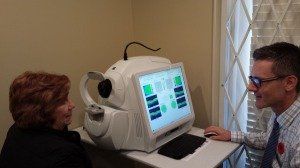
Optometrists have always been the doctors to see whenever you have a problem with your eyes. One of the very important roles of your optometrist is to separate minor problems from more serious ones and then arrange for prompt follow up including treatment if indicated. Whereas this has often involved a referral to an ophthalmologist, for certain diseases including glaucoma and severe eye infections and inflammations, optometrists will soon be able to independently manage these conditions within their offices.
“This is a big win for Albertans” says Dr. Tom Wilk of Mountain View Optometry in Cochrane. “We are trained to manage these conditions, but have been prohibited from doing so legislatively. The changes in practice scope will be much more convenient for our patients”, noting that referral to a specialist involves a trip into Calgary and often a lengthy wait to be seen.
As greater responsibility will be placed on optometrists to manage more types of disease, many are acquiring advanced instrumentation and technology to give them better information. “We are going to be held to the same standard as the specialists (for managing disease) so we need to have the same equipment as they do” says Wilk.
One such new piece of technology is the OCT, short for “Optical Coherence Tomography”. It’s used to give the eye doctor a deep-tissue cross section of different parts of your eye, essentially providing a cutaway-view of the various tissue layers. “The OCT only takes a few minutes to do a scan, nothing touches your eye and it’s completely safe and painless” said Dr. Wilk. “Examining your eyes without it would be like trying to diagnose a broken arm without an X ray, or a ruptured disc without an MRI”.
Many eye diseases have no symptoms in their early stages, making the OCT useful as a screening tool as well. “Having the kind of information the OCT provides, about what’s happening beneath the surface, is invaluable” notes Wilk. While not everyone needs to have an OCT, optometrists at both of Mountain View Optometry’s locations recommend it for people with certain risk factors. Coverage under Alberta Health Care may be accessed for initial or future OCT scans if a risk factor is identified during your eye exam.
As always, education is a big part of the care provided at Mountain View Optometry. Their Calgary eye doctors always review the results of all tests in detail with each of their patients and ensure enough time is allotted for questions and addressing any concerns. “We are looking forward to providing even more comprehensive eye care for our patients and playing a larger role in their eye health care” said Dr. Wilk.